
When 1 in 4 European Squid Products Are Mislabeled, What Defense Does Your Supply Chain Need?
A new study published in Food Control reveals that nearly one quarter of squid products sold in Brussels and Milan are mislabeled. This is not an isolated compliance gap but a symptom of a global seafood transparency crisis. For European buyers, what does this mean — and why is Angfa uniquely positioned to be your first line of defense against such risks?
Angfa Connect Core Topic — In an era of fragile consumer trust, how can importers and food service operators ensure every batch of squid is exactly what it claims to be? The answer lies not in more frequent dock inspections, but in embedding scientific verification at the very source of the supply chain. Below, we combine independent research data with Angfa’s source-control practices to expose industry pain points and demonstrate the foundational capabilities of a truly trustworthy sourcing partner.
🔬 Research Alert: 25% Mislabeling – Far More Than a Label Problem
In February 2026, the marine conservation organization Oceana together with the peer-reviewed journal Food Control published an investigation covering Brussels and Milan (Oceana press release). Researchers collected 198 squid samples from supermarkets, fishmongers and restaurants. DNA barcoding revealed:
of products mislabeled by species
lacked species name or catch area
claimed “Atlantic/Mediterranean” but originated from the Pacific
of fresh/frozen squid in Brussels fully complied with EU labeling law
Even more troubling: 96% of restaurants could not provide any species information for the squid they sold — a decade after Oceana first exposed large‑scale seafood fraud in Brussels restaurants. For B2B buyers, this means every incoming container is a potential compliance bomb. Traditional supplier audits or price‑driven agency models simply cannot penetrate these grey areas.
⚙️ The Angfa Answer: Science + Full Traceability = Quantifiable Trust
We know that a paper certificate or a “long‑term relationship” cannot eliminate species fraud. That is why Angfa pushes quality control all the way back to before raw materials ever leave the dock, building a “no‑surprise” supply chain through four pillars.
🔍 1. DNA Barcoding: A Scientific ID for Every Batch
For high‑risk products (e.g., Loligo duvauceli, Uroteuthis edulis, Loliolus beka), Angfa commissions Eurofins to perform species identification using DNA barcoding. The report clearly states the Latin name and match percentage (>99%), ensuring that what you receive is 100% consistent with the contract. When the industry suffers a 25% mislabeling rate, we close the “species substitution” loophole with scientific evidence.
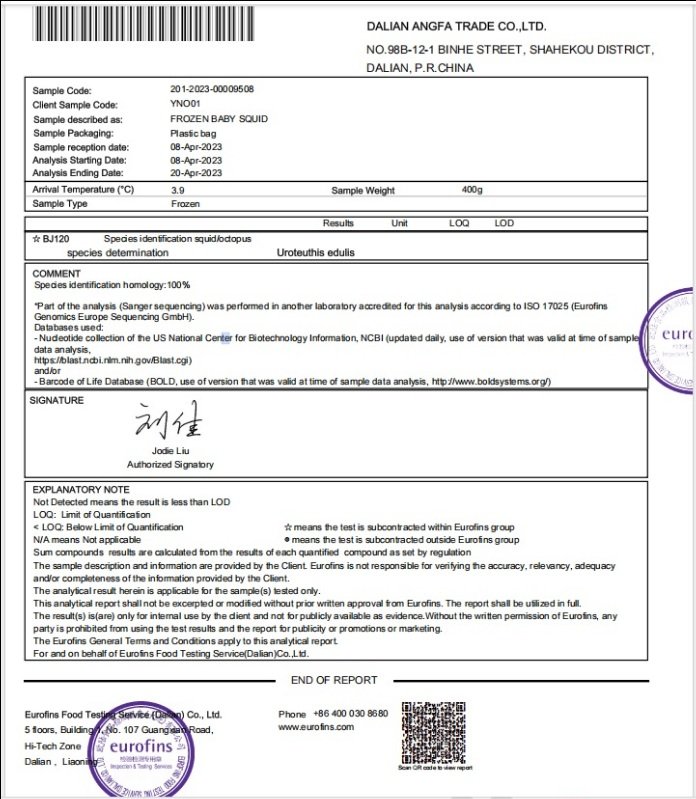
📄 View sample DNA test report (internal reference)
🌊 2. Quantified Freshness: TVB‑N Stricter Than International Standards
Total Volatile Basic Nitrogen (TVB‑N) is the internationally recognized core freshness indicator. Our internal acceptance standard is ≤15mg/100g — significantly tighter than many market requirements. All batch TVB‑N data is entered into our system and combined with pH and TMA to form a multi‑dimensional freshness matrix. For you, this means: freshness locked in at the source translates directly into stable end‑product texture and longer shelf life.
🦠 3. Microbiological Baseline: Proactive Interception, Not Passive Testing
Safe processing begins with safe raw materials. Referring to EU regulations (EC) No 2073/2005 and (EC) No 852/2004, we screen incoming raw materials for pathogens such as Salmonella and Listeria monocytogenes where applicable, and additionally monitor hygiene indicators including Enterobacteriaceae and total aerobic count. Any positive result triggers immediate rejection of the entire batch and a supplier corrective action. This “preventive microbiological baseline” stops risks before production even starts, saving you from container destruction or RASFF notifications due to non‑compliant end products.
📦 4. Supplier Dynamic Evaluation & Cloud Sharing: Transparency Is a Process, Not a Slogan
We maintain a “Quality Acceptance Standard Manual” for each key supplier, integrating customer requirements, Chinese national standards and EU regulations. Through quarterly KPIs (quality, delivery, compliance) we drive continuous improvement. At the same time, we proactively share quality data and trend analysis with strategic suppliers via our cloud‑based system, turning “after‑the‑fact inspection” into “pre‑shipment empowerment.” You receive a complete documentation package (DNA reports, TVB‑N trends, microbiological tests, loading temperature records) that can be used directly for your own compliance audits — no need to spend management time on secondary verification.
• Avoid commercial fraud & legal risk – DNA evidence + full traceability eliminate “label fraud” that leads to rejected containers and claims.
• Consistent product quality – Uniform freshness parameters (TVB‑N ≤15) guarantee your menu items or processed products taste and perform the same every time.
• Simplify supply chain management – From fishing grounds to port, we act as your embedded quality team, so you don’t need to build a cross‑border inspection department.
• Honor sustainability commitments – Priority sourcing from MSC/ASC certified origins or rigorous on‑site supplier audits.
📊 From Research Data to Business Decision: Why Choosing Angfa Means Choosing Certainty
The Oceana study reflects a cold industry reality: traditional sourcing models cannot handle today’s transparency challenges. When one quarter of squid may be mislabeled, and when more than 70% of “local catch” claims actually originate from distant oceans, relying on relationships or low prices only accumulates risk.
Angfa takes the opposite path: we replace subjective judgment with scientific verification, and vague promises with real‑time data. Our clients are not merely buying squid — they are buying an engineered risk‑control system — from DNA identification to -18°C cold chain monitoring, from TVB‑N dashboards to supplier cloud collaboration. All of this is documented in our Source‑to‑Supply Excellence framework.
🔗 Authoritative Links & Further Reading
- 📄 Oceana Official Report: Widespread squid mislabeling in Brussels and Milan (February 2026)
- 📖 Food Control journal article (forthcoming; search “Squid mislabeling Brussels Milan 2026” on ScienceDirect)
- ⚖️ Commission Regulation (EC) No 2073/2005 (microbiological criteria for foodstuffs)
- 🚢 Angfa: Source‑to‑Supply Excellence – Full‑chain quality control from source to delivery
🤝 Partner with Angfa – Turn Uncertainty into Controllable Parameters
Whether you are a European importer, restaurant group or food manufacturer, when you receive a quote we invite you not only to ask the price, but to request: the batch‑specific DNA species report, the latest TVB‑N value, and the supplier’s microbiological trend data. This is the standard we deliver to our partners every day.
Contact us today! →